
Top SEO Myths: Popular Misconceptions that Affect Your Work
Many SEO specialists still believe in dozens of myths, which hinders effective work. We’re examining 20 misconceptions and explaining why it is time to abandon them.
Myth 1: SEO is a One-time Task
This misconception is certainly among the top myths in SEO among beginners and entrepreneurs. Clients often ask: "Can we launch SEO once and forget about it?" The answer is: no. It is a continuous process that requires constant attention.
Search engine algorithms are constantly changing. Google releases hundreds of updates each year to improve search quality. If you once set up your site and forgot about it, sooner or later you will drop far down in the search results.
Competition is also growing: new players are emerging who are actively working on optimization. To avoid losing the positions you have already gained, you need to keep up with new projects.
Moreover, your site is likely changing constantly. You add new pages, offer products or services. Each of these pages needs optimization: selecting keywords, specifying metadata, gathering external links.
The recommended minimum for optimization work is a monthly or quarterly check. The more competitive the niche and the more global the goals, the more often you need to delve into the task.
Myth 2: Using Keywords Alone Ensures Success
Many believe that optimization is merely about adding keywords to texts, as if this automatically ensures top rankings. The days when search engines relied heavily on exact phrase matches are long gone.
With the introduction of Google's Hummingbird algorithm, the focus has shifted towards understanding user intent rather than simply counting keyword occurrences. The algorithm now analyzes the context and semantic meaning of queries. This means that it's not enough to just insert a phrase like "CRM for small businesses"; it is crucial to understand what the user is specifically interested in — be it service comparisons, genuine reviews, guides, or something else.
Experts, including Rand Fishkin, founder of Moz and CEO-Evangelist, emphasize that keyword targeting today impacts rankings by less than 15%. It is far more important to create valuable content that genuinely answers the user's query.
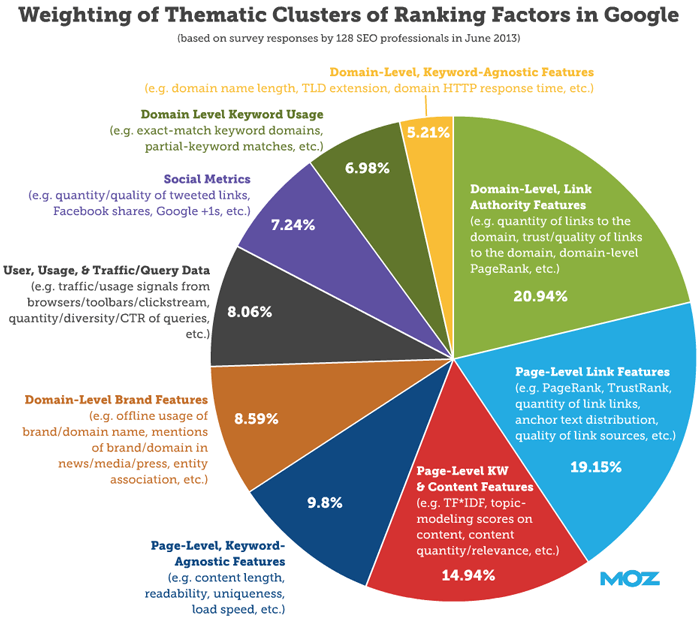 Thematic Clusters of Ranking Factors in Google
Keywords still play a role — without them, it is impossible to determine which query you aim to address. However, simply embedding keywords in the text is insufficient. One needs to consider why the user is making the query and provide a comprehensive and useful response.
Myth 3. Being at the Top Equals Sales
It seems logical: if a website ranks first on Google, a stream of customers is guaranteed. People search — people find — people buy.
In reality, reaching the top positions is only half of the equation. The other half concerns what happens on the site. If the page does not address the user's query, is inconvenient, or creates distrust, no amount of traffic will help. Additionally, not every query carries commercial value. One might rank first for the query "how to choose a pump," yet not sell a single one. This happens if the page informs rather than leads to a purchase.
Myth 4: Results are Visible Instantly
Everyone desires quick results: create a website, add a few keywords, publish an article, and by tomorrow, you are on the first page of search results.
In reality, things are different: search engine optimization (SEO) is a long-term strategy, and neither Google nor any other platform ever guarantee an immediate top ranking. Even if you analyze keywords, competitors, and improve the website, no one can promise an instant rise in positions.
Experienced specialists never promise "top ranking in a week," as ranking depends on dozens of factors, many of which are beyond anyone's control: domain age, content quality, backlink profile, user behavior, and the technical state of the website.
For instance, Neil Patel, co-founder of NP Digital and owner of Ubersuggest, shares in his blog that it took years of regular publishing and optimization to reach a stable traffic of 700 thousand users per month. Other projects, despite having less content, showed better results because SEO does not work according to a template.
Myth 5: Behavioral Factors do not Affect SEO
Google has never explicitly acknowledged that behavioral factors influence ranking. SEO specialists still have doubts, considering that the algorithms are too complex.
In 2015, Rand Fishkin conducted an experiment: he asked his followers on X (formerly Twitter) to enter a specific query into Google, click on the first result, quickly return to the search results, and then choose the fourth result.
Seventy minutes later, the fourth link rose to the top of the search results. This occurred without any link building or site updates — solely due to user behavior: Google observed the mass "bounce" from the first result and higher engagement with the fourth, subsequently altering its ranking priority.
That’s not a coincidence but rather logic. If people visit a page and immediately leave, it indicates a lack of interest. Conversely, if users stay, read, and do not return to the search, it suggests they found what they were looking for.
Myth 6. Creating a Large Volume of Content Solves Everything
A lengthy text in itself is not a guarantee of success. Yes, Google respects detailed and useful articles, especially after the launch of the Hummingbird algorithm. But the question is, does the text contain anything useful?
Most voluminous articles are fluff: repetitions, unnecessary paragraphs, SEO filler. Algorithms have learned to determine quality: they look at behavioral metrics, engagement, uniqueness, and — importantly — added value compared to competitors.
Moreover, a long text is not always the best for the user. Sometimes they need specifics: a list of features, price, a "Buy" button. Copy-pasting 5000 characters won't help if the user leaves after 10 seconds.
Myth 7: Duplicate Content Does Not Affect Ranking
Google has stated: "Duplicate content on a site is not grounds for action on that site unless it appears that the intent of the duplicate content is to be deceptive and manipulate search engine results."
However, it's not that simple.
Indeed, Google does not penalize for ordinary duplication. But the issue lies not in sanctions, but in loss of efficiency. When a search engine encounters several pages with identical or very similar content, it cannot accurately determine which one to display.
The outcome:
- You do not control which URL appears in the search results.
- Internal competition between duplicates dilutes behavioral signals.
- There is a lower chance that the user will see the relevant version of the page.
- The overall uniqueness and value of the site decrease in the eyes of the algorithms.
In the PR-CY Website Analysis service, you can find out how many pages on the site have identical Titles or H1s written by the optimizer, as well as whether there are pages where the Title and H1 are duplicated.
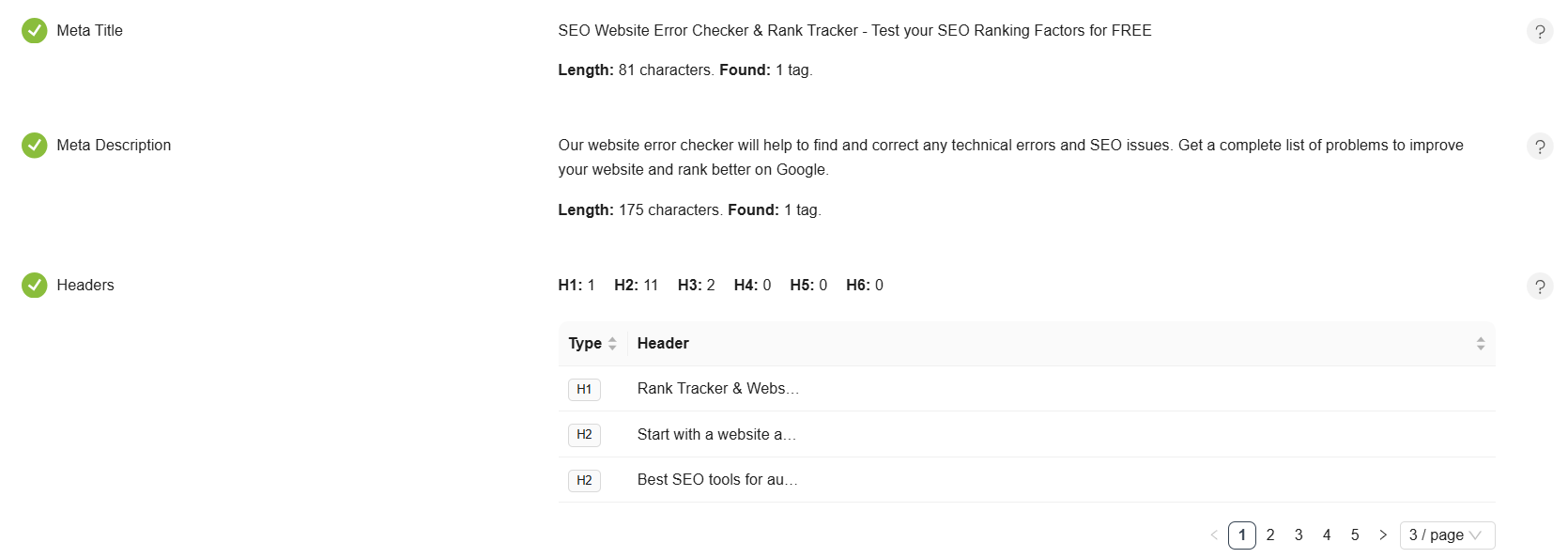 PR-CY Website Analysis service interface
Myth 8: Social Signals Help Improve Rankings
At first glance, it might seem that if thousands of people like and share your article, it must be valuable, and therefore, search engines should rank it highly.
There is a correlation between social networks and SEO, but not a causation. Good content will both rank higher and receive more likes, but this does not mean that ranking depends on likes.
Search engines do not consider likes, shares, and the number of followers as ranking factors. Neither Facebook, X, nor other social networks pass "link juice" in the same way that an external link from a relevant website does.
Nevertheless, social signals indirectly influence optimization:
- They attract traffic, and behavioral signals (engagement, time on site) can impact ranking.
- Social networks help distribute content. Journalists, bloggers, and other sites may notice it, leading to backlinks.
- In some cases, a surge in traffic from social networks can coincide with an increase in ranking, especially for new pages.
Myth 9. SEO is Only for Search Engines
Many still perceive SEO as a technical process exclusively tailored to Google's algorithms: meta tags, keywords, sitemap.xml, and so forth. This misconception leads to the belief that SEO exists solely "for machines," not for people.
In reality, modern SEO is primarily about optimizing for users. Since the introduction of Google's Hummingbird algorithm, it has become evident that to rank high, a website must answer real questions, provide a good user experience, and offer value.
Even in its technical aspects, the focus has shifted to user-friendliness, fast indexing, and making the site understandable for people, not just "pleasing the bot."
Myth 10: The More Backlinks, the Better
It used to be believed that to achieve top rankings, one simply needed to accumulate more links. Many still purchase dozens and even hundreds of links without paying much attention to their quality, type of anchor, or relevance.
Google has long since revised its stance. The number of links does not equate to quality. Since the introduction of the Penguin algorithm, websites with unnatural link profiles have begun to lose their rankings or face penalties.
Today, Google evaluates context and naturalness. Links with branded anchors, URLs, general phrases, or those simply organically integrated into the text, and importantly, from relevant sites, work much better.
Myth 11. Technical SEO Doesn't Matter
Technical SEO is the foundation upon which all other optimization efforts must be built. Without it, those efforts may simply fail to work.
A simple example is an XML sitemap. While it does not directly factor into ranking, as Google representatives stated back in 2008, the case of Casey Henry illustrates its importance. Implementing a sitemap generator reduced the indexing time for new pages from 1375 minutes to just 14 minutes. If a page isn’t indexed, it won’t appear in search results at all, regardless of its content quality.
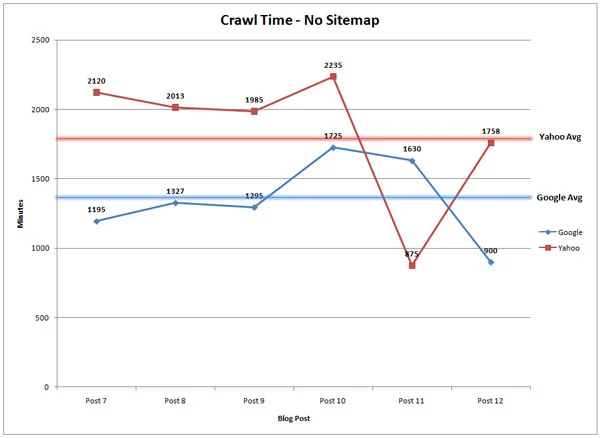 Crawl Time without Sitemap
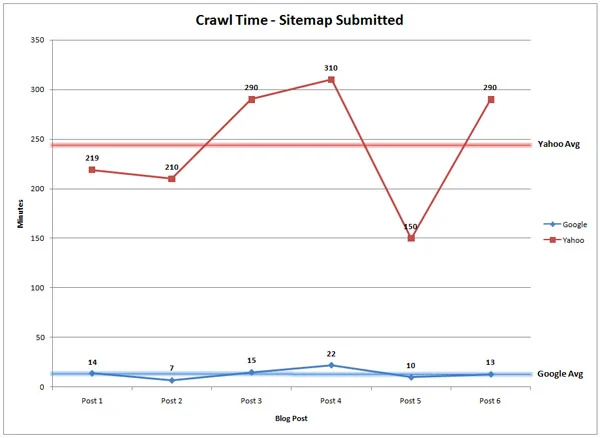 Crawl Time with Sitemap
The same applies to the robots.txt file and noindex meta tags: they do not influence the ranking of a site directly but can completely block access to essential pages. You might not even realize that you are losing traffic.
Key elements for technical optimization include:
- Creating and regularly updating the sitemap.
- Ensuring the robots.txt file does not block important sections.
- Using rel=canonical if there are duplicate pages.
- Fast site loading times and responsive design.
- Absence of broken links and indexing errors.
Myth 12. Paid Advertising Does Not Affect SEO
SEO is about "free" organic traffic, while PPC deals with paid advertisements. These channels seem distinct: one relies on links and content, the other on bids and budget. So why can paid advertising influence SEO?
Formally, this is indeed true: search engines do not boost your organic rankings simply because you purchase ads. Advertising and search algorithms are separated.
However, in practice, contextual advertising does help SEO:
- Keyword Testing. Through Google Ads, you can quickly understand which queries bring visitors and conversions. This helps in choosing keywords more accurately for SEO.
- Increasing Brand Awareness. When a user sees a site in both ads and organic results, it strengthens trust and increases the likelihood of a click.
- Improving Behavioral Metrics. Advertising attracts a more targeted audience that stays longer on the site, views more pages, and performs more desired actions. Search engines may take these indirect signals into account.
- Quick Traffic at the Start. While SEO has yet to yield results, ads can be the primary source of traffic and provide the site with an initial boost.
Paid advertising does not directly influence rankings in search results, but it helps to understand audience behavior faster, gather data, and support SEO growth — especially in competitive niches.
Myth 13. SEO is Easy to Do on Your Own
There are numerous guides, courses, and checklists that create the illusion of simplicity: "Just choose the keywords, just add them to the site." This is often heard from entrepreneurs who are surprised by the pricing from SEO specialists.
SEO is not just about keywords and texts; it involves technical optimization, site structure, loading speed, adaptability, proper redirects, internal linking, behavioral metrics, competitor analysis, and constant monitoring. Additionally, it requires adjusting to regular algorithm changes.
Basic SEO can be mastered, but expecting this to be enough for sustainable growth is naive. In a competitive niche, it is simply dangerous for the business.
Myth 14: A New Website Cannot Reach the Top
A new website can achieve top positions much faster than commonly believed. It all depends on the quality of the content, the technical foundation, and user behavior factors.
Yes, new domains lack a significant background, but Google favors fresh and relevant content. Nowadays, algorithms are more focused on meeting user intentions rather than the age of the site. This means that if your site is helpful, it will get noticed.
How to Expedite Reaching the Top:
- Configure an XML Sitemap to ensure Google quickly indexes new pages.
- Share content through social media to accelerate crawling and increase reach.
- Use Ping services to notify search engines about new publications.
- Write content based on real queries, particularly long-tail keywords.
- Create useful, engaging, and well-structured pages.
Myth 15. The Search Engine Will Automatically Find and Index All Pages
In an ideal world, a newly published page would be indexed by search engine robots almost immediately. In reality, this process can take anywhere from a few hours to several days, particularly if the website is new or does not generate significant traffic. Without an XML sitemap, notifications of new publications, and external signals, the page may remain unnoticed for an extended period.
It is essential to use plugins, such as the XML Sitemap Generator tool, which assists in creating a sitemap. This way, search engines receive a direct signal about new pages.
 XML Sitemap Generator tool Interface
The PR-CY website analysis service offers a feature for daily checks. Simply enable it, and the service will monitor your site, sending notifications to your email if anything important occurs. This ensures that you won’t miss anything crucial and can correct errors promptly.
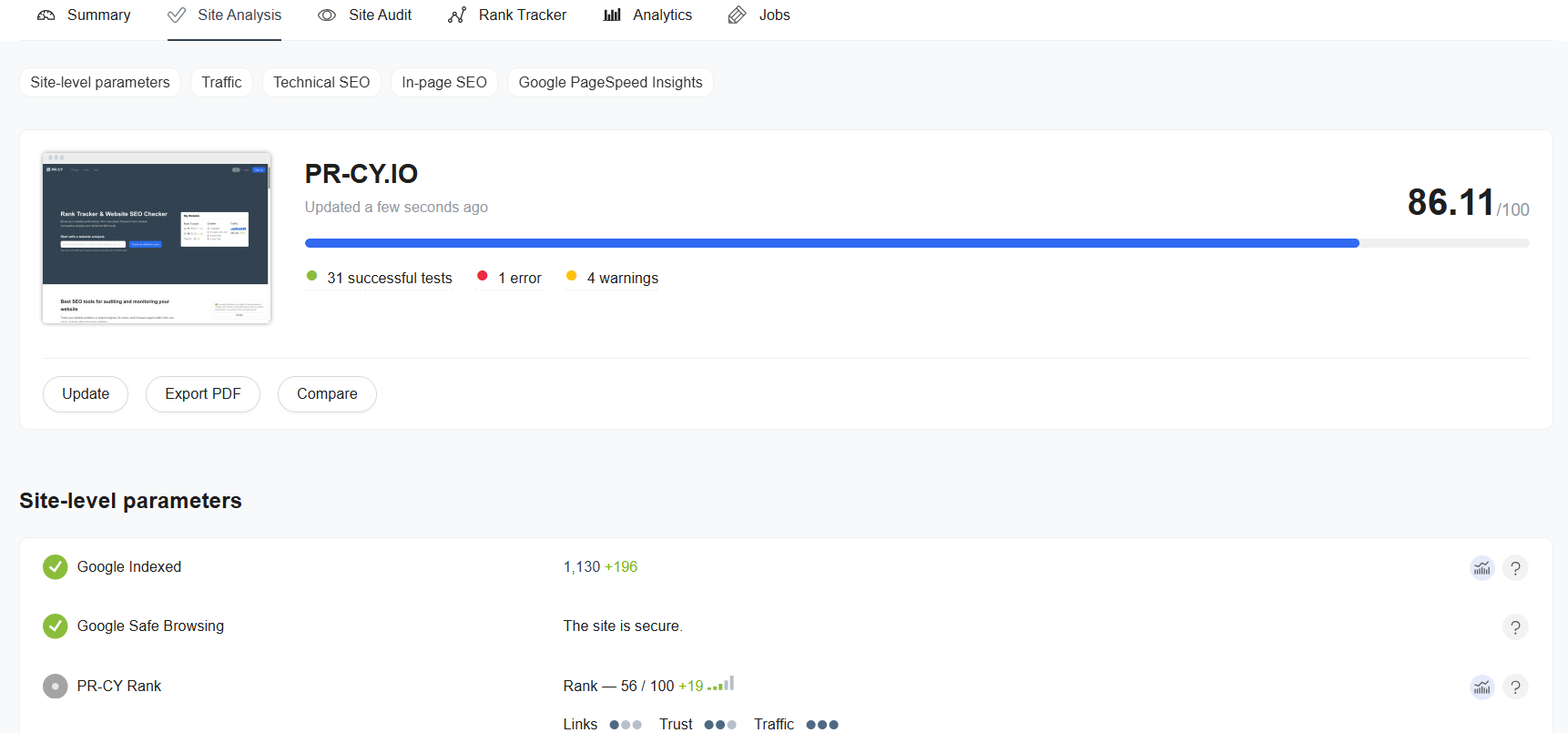 PR-CY Website Analysis service interface
Myth 16: Guest Blogging is Dead
Since 2014, following Matt Cutts's statement "stick a fork in it; guest blogging is done for SEO," there has been a perception that guest blogging is now forbidden or ineffective.
However, the discussion was about "junk" guest content created solely for SEO links. Google cannot distinguish between a guest post and an internal one. Moreover, hundreds of reputable publications publish articles from external authors, and this yields results.
Publish where your expertise is relevant and where there is an active audience.
Myth 17. Collecting Keywords is Unnecessary
With the development of semantic search through Hummingbird and BERT, a new misconception in SEO has emerged: keywords are no longer needed, and the main focus should be on writing about the topic. This is only partially true.
Algorithms have indeed learned to understand the intent behind queries. However, without keyword phrases, you won't know what formulations users are employing, what exactly they want to find, and what their expectations are. Keyword analysis helps to:
- understand demand and competition;
- find "long-tail" keywords and niches;
- avoid irrelevant queries;
- create page structures that meet real needs.
Myth 18: Domain Zone Affects SEO
Some believe that only websites with .com domains rank well, and that new zones like .guru, .store, .tech, or .club harm SEO.
In practice, the domain zone does not directly affect rankings. What matters is not what's in the address, but what's on the website. Search engines look at value, relevance, user behavior, and links.
Myth 19. H1 Tags are The Key to High Rankings
Classical SEO guides often state that H1 tags are mandatory and critical for ranking, and their absence leads to "penalties."
However, modern algorithms understand the structure and content of a page without strict reliance on markup. While H1 tags do enhance readability and form the page's logic, they do not independently affect rankings.
All these popular SEO myths and misconceptions prevent us from seeing the whole picture. Believing in them means wasting resources. Today’s search engine optimization is not about a set of tricks, but a comprehensive approach involving content, technical foundation, user experience, and common sense.
🍪 By using this website, you agree to the processing of cookies and collection of technical data to improve website performance in accordance with our privacy policy.