
Internal Linking for E-commerce Websites: Strategies, Examples, Checklist
Brief Summary
Internal linking for an e-commerce website is a controlled way to distribute user attention and page authority across the site. It helps new URLs get indexed faster, reduces the number of orphan pages, and gently guides visitors toward a purchase without disrupting the funnel.
- You will learn which three internal linking strategies work most often in e-commerce and how to recognize them in practice.
- You will understand what has changed in SEO — AI search, crawl budget, and faceted navigation—and how these changes affect internal linking.
- You will get a checklist showing where to place links—categories, product pages, the blog, breadcrumbs, and related products — and where it is better not to place them.
Who Should Read This Article:
- SEO specialists and marketers who manage an online store and want to grow rankings for commercial queries without bloating the index.
- E-commerce owners who want to improve both SEO and conversion rates rather than choosing one over the other.
- Content teams that create category pages, collections, and blog posts and want their articles to actually drive traffic to products.
This article is based on Neil Patel’s research into internal and external links in e-commerce. We have preserved the logic of the study while supplementing the material with current practices and search engine changes.
Internal links are hyperlinks that lead to other pages on the same website. Together, they form a link graph. The process of managing this graph — which URLs are connected, which anchor texts are used, and where the links are placed — is commonly referred to as internal website linking.
What Has Changed in E-commerce SEO and Internal Linking
Since 2024, SEO has become stricter about quality and more demanding when it comes to the structure of large websites. This is especially noticeable for online stores, which often have numerous URLs, filters, sorting options, inventory statuses, and duplicates. Here are the three changes that have had the greatest impact on internal linking:
AI search (AI Overviews / AI Mode). Generative answers in search results increasingly occupy the top of the screen and include links to sources. To be cited in these answers, a website must be easy to understand: it needs a clear hierarchy, unambiguous URLs, and strong connections between topics and sections. Internal links, breadcrumbs, and related product or category blocks help search systems determine which pages are most important and how they are connected.
Crawl budget and crawling efficiency. For large and frequently updated websites, Google specifically emphasizes that managing URL inventory is essential: avoid generating millions of filter combinations and long redirect chains. There is also an important nuance: if you want to conserve crawling resources, it is better to block unnecessary URLs via robots.txt rather than rely heavily on noindex, because noindex pages still need to be crawled before they can be excluded.
Faceted navigation and duplicate pages. In online stores, filters and sorting options can easily create index bloat. Therefore, only pages that address real search demand — for example, popular combinations such as “white sneakers size 42” — and provide unique content should be indexed. Everything else should be handled through canonicalization, crawl restrictions, and careful internal linking that does not point to pages you do not want in the index.
There is another important factor. Search engines are more aggressively removing thin pages and templated content from search results. In e-commerce, this often means thousands of low-value filter landing pages, pages with very limited product selections, and internal link blocks that look like attempts to manipulate rankings. Therefore, the “more links” approach is less effective than using the right links: links to useful, indexable, and stable pages.
FAQ Section
Do internal links need to be changed because of AI Overviews?
Not completely. However, it is worth making the structure easier to understand: categories → subcategories → products, breadcrumbs, contextual links in category and blog content, and a minimum number of low-value URLs generated by filters.
Can noindex be used to conserve crawl budget?
If the specific goal is to reduce crawling, Google advises against relying on noindex: the page will still be requested and then excluded. For URLs that do not need to be crawled, robots.txt is often more effective, provided that important pages do not link to them.
Which filters should be indexed?
Only those that have stable demand and provide unique value: popular combinations and dedicated filter landing pages for categories with proper content, a suitable product selection, and clean URLs.
What Makes Internal Links in E-commerce Unique: SEO and Conversion
E-commerce websites usually contain many pages, which means they can be promoted effectively through internal links, although this is not always technically possible. For example, SEO specialists seek to minimize drop-offs between steps in the sales funnel, and a new link on a page may interrupt the path to conversion. If you want to guide a customer through the funnel, remove anything that may distract them.
In practice, internal linking in an online store is always about balance:
SEO. Links help search engine crawlers navigate the website, discover new URLs faster, and understand the hierarchy of categories, subcategories, collections, brands, and products.
Conversion. The same links can dilute focus at critical stages such as the cart and checkout. Therefore, the sections with the most links are usually categories, collections, product pages, and content pages rather than the checkout.
A good internal link answers two questions: does it help the user, and does it lead to a canonical, indexable URL? If a link leads to a redirect, a 404 page, a noindex page, or a low-value filter URL, you lose in terms of user experience, crawling, and ranking potential.
FAQ Section
Where should internal links be placed in an online store?
The best places are usually categories and subcategories, category descriptions and FAQs, product pages featuring related products, alternatives and brands, blog posts and guides, and breadcrumbs.
Should links be placed in the cart and checkout?
If a link distracts users from making a purchase, usually not. Only links that help customers complete their orders should remain, such as links to delivery, payment, returns, and contact information.
How many internal links are acceptable on a page?
There is no fixed limit. The guideline is simple: if a link block looks like an SEO listing and does not help the user, it is a sign that it should be reduced and redesigned.
Internal Linking Strategies for Online Stores: Three Models with Examples
To understand how links affect the performance of e-commerce websites, you need to answer two key questions:
- Which pages are the highest priority for this website?
- Why is the company targeting these specific pages?
Below are three internal linking models based on examples from e-commerce companies. To quickly assess your own website, start with Google Search Console: open Links → Internal Links. This will show which URLs receive the most internal links. Keep in mind that the report displays a sample and is usually limited in the number of rows. For large websites, the analysis should therefore be supplemented with server logs, a crawler, or internal click analytics.
Example 1: A Coffee Company
Strategy: Placing internal links on collection pages — product selections built around promotions or holidays — as well as on product category pages and in blog content.
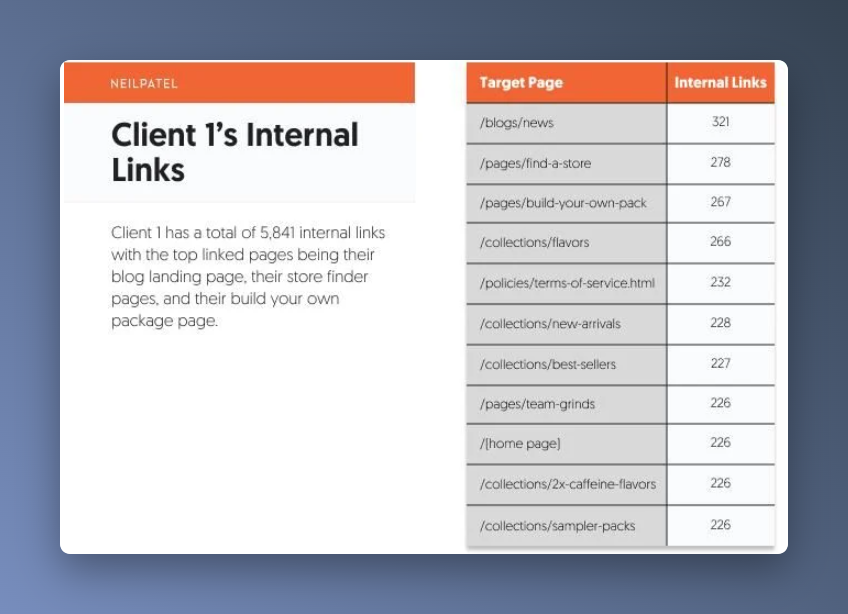
Internal links on the coffee company’s website pages
GSC showed 5,841 internal links on the website. Three pages account for 15% of all links:
- A blog landing page;
- The store locator page;
- The page for creating a custom product set.
A significant proportion of the website’s internal links point to collections. This is normal for this type of website because collections guide users through the conversion funnel and help visitors decide what to buy.
The company decided to direct a significant share of links to product collections rather than individual product pages, even though product pages are higher in the funnel, for two reasons:
- A link to a product category or collection strengthens the subfolder as a whole.
- It preserves the visitor’s sense of control, unlike an obvious linear path created by a marketer from a landing page to a product purchase. If the strategy is too explicit and direct, the visitor may leave the website.
Product categories occupy an important place in the website hierarchy. They establish relationships between elements, showcase the product range, and support seasonal promotions, holiday collections, and other traffic acquisition tools.
Importantly, categories are less volatile than product pages. A particular item may be discontinued or go out of stock, while a category changes much less. Therefore, these internal links do not need to be redirected frequently.
The company places ten times fewer links to products than to categories: the total number of category links is measured in the thousands, while links to individual products are measured in the hundreds.
In addition to category pages, the company uses links to direct visitors to the blog. Blog posts group similar URLs. They give visitors access to an overview of all related product collections connected through internal links: a blog link leads to a category page, and that category page links back to the same blog post.
Example 2: Next, an Artesian Water Brand
Strategy: Focusing on contact details, frequently asked questions, company information, and delivery information.
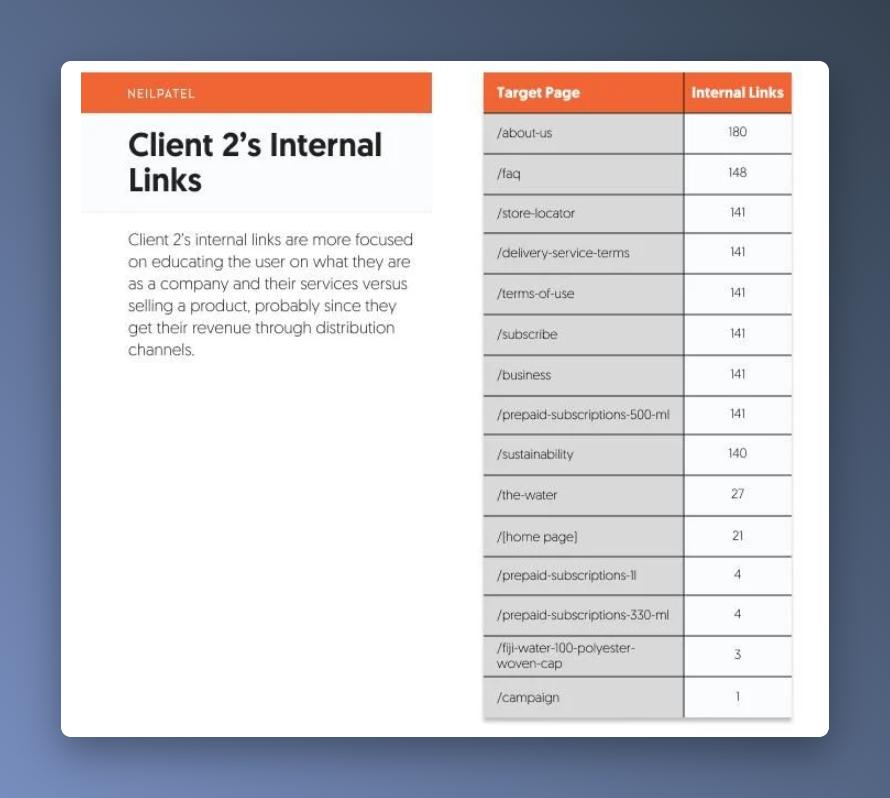
Internal links on the artesian water company’s website pages
The website contains 1,374 internal links. The company takes a different approach to internal linking. While the coffee website builds a strong subfolder containing product collections, Next’s top ten pages are informational. For example, the three pages with the highest number of internal links are:
- About Us;
- FAQ;
- Delivery Terms.
These three pages account for 34% of all internal links on the website. Although the website includes a /products/ subfolder, these pages contain no internal links to product pages at all.
This approach is explained by the company’s business model. Its goal is not to build a conversion-focused website because it already has other established sales channels. The website serves an informational purpose, increases brand awareness, and educates the company’s customer base.
Example 3: A Bicycle Retailer
Strategy: Using the maximum possible number of links without tying them to a standard website hierarchy. Products, brands, components, collections, and categories are tightly interconnected.
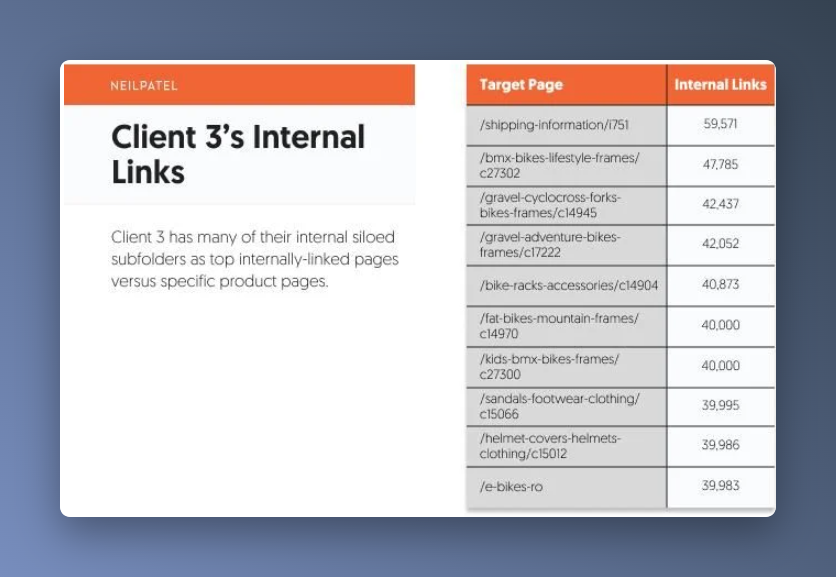
Internal links on the bicycle retailer’s website pages
The website with the highest number of internal links in the study had 7,743,886 links. The delivery information page received the most links, followed by two category pages. Together, they accounted for only 2% of all links. However, the main difference from the other websites was its more networked, fragmented link graph rather than a strict hierarchy.
Other e-commerce websites typically use standard subfolders such as /product/ or /category/ within their hierarchy, leading to lists of products. The third example works differently.
Most pages do not follow a conventional hierarchy, so it is impossible to determine the exact number of links to categories and products through GSC. This is due to the nature of the market: users search for specific bicycle models or compatible components. Broad categories such as MTB, Downhill, or Cross-Country can become so large that they are inconvenient for customers to use when many products are available.
Therefore, instead of generic subfolder names, the store uses specific model or brand names, although they are not interconnected through internal links. At the same time, bicycle collection pages, high-level category pages, and the company’s blog pages contain many internal links. Their number is also impossible to calculate because of the unconventional structure.
FAQ Section
Which strategy is best for SEO in an online store?
The strategy that matches the business goal and catalog structure. In most cases, two foundations work best: strong categories and collections, plus related content such as blog posts, guides, and FAQs.
Why does GSC show unexpected pages as internal link leaders?
Because sitewide pages such as delivery, returns, and contact pages often appear at the top, along with technical URLs such as filters and pagination pages if the website links to them extensively. This is a sign that the structure needs to be cleaned up.
Does every store need a network structure like the bicycle retailer?
Not always. It is useful when search demand is model-specific and users search for particular brands, models, or SKUs. If demand is category-based, a hierarchy is often simpler and more stable.
Conclusions: Which Internal Linking Strategy to Choose
The first and third examples are the most interested in increasing the number of conversion funnels on their websites, so they use product collections rather than links to individual items, reducing the risk of 404 errors. Because the first company focuses on the quality of its blog content, it fills pages with a large number of links. Its authors emphasize content—for example, the coffee company integrates blog articles into its funnel. This creates opportunities for both internal and external links. Despite the fragmented subfolder structure of the bicycle store, its pages also contained a large number of internal links.
Unlike these companies, Next uses a fundamentally different distribution model and therefore does not need its pages to focus on conversions. Its main goals are to increase brand awareness, inform potential sellers about delivery terms, and introduce visitors to the company.
In every case, links support specific goals. This should be taken into account when creating an e-commerce website and selecting pages for internal links.
FAQ Section
Which pages should be strengthened with internal links first?
Pages that generate revenue and satisfy demand: key categories, subcategories, collection landing pages, popular brands, and pages with high conversion rates or margins.
What should you do with product pages that frequently become 404 pages?
Try not to build your internal linking structure around products alone. Strengthen categories and collections, and carefully handle out-of-stock products by offering alternatives, replacements, or an archive where appropriate, and using the correct status codes — 404 or 410 — for items that have been permanently removed.
Can internal linking cause harm?
Yes. This can happen if you bloat the index with filter pages, place links to redirects or error pages, or turn a page into a long list of SEO links. This is more likely to do harm than good.
Checklist: How to Set Up Internal Links in an Online Store
Below is a set of techniques that support both SEO and sales. They provide a foundation for tasks such as internal linking between online store categories and adding internal links to product pages. They can be implemented gradually, starting with the most important pages.
- Create a clear catalog hierarchy. Main categories should be accessible within two or three clicks from the homepage. Subcategories should be grouped logically. This reduces click depth and improves crawling.
- Add breadcrumbs and make them clickable. They serve as both a navigation tool and a structural signal. This is especially useful for large catalogs.
- Connect product pages to related products. Blocks such as “Related Products,” “Frequently Bought Together,” and “Similar Products” are forms of internal linking that directly affect average order value and browsing depth.
- Strengthen categories and collections, not just products. Categories are more stable: products disappear, while the structure remains. Links to categories are less likely to turn into 404 errors.
- Create content that sells: blog → categories/collections → products. In guides and articles, place contextual links to relevant categories and collections using clear anchor text such as “running shoes” or “budget smartphones” rather than “read more.”
- Do not link to pages you do not want indexed. If a URL is blocked in robots.txt, marked as noindex, or canonicalized to another URL, remove internal links to it from important pages whenever possible. Otherwise, you waste crawl resources and create noise in the website structure.
- Manage facets and filters. Index only preselected combinations with proven search demand. All other filters should be handled technically through canonical tags or robots.txt and should not receive active internal links.
- Links should lead to final pages returning a 200 status code. Make sure internal links do not lead to redirect chains or 404 pages. This is important for both user experience and crawling.
If you need to quickly find broken pages, redirects, and other technical issues, you can run your website through PR-CY’s website analysis tool and start by fixing errors that interfere with indexing and consume crawl resources.
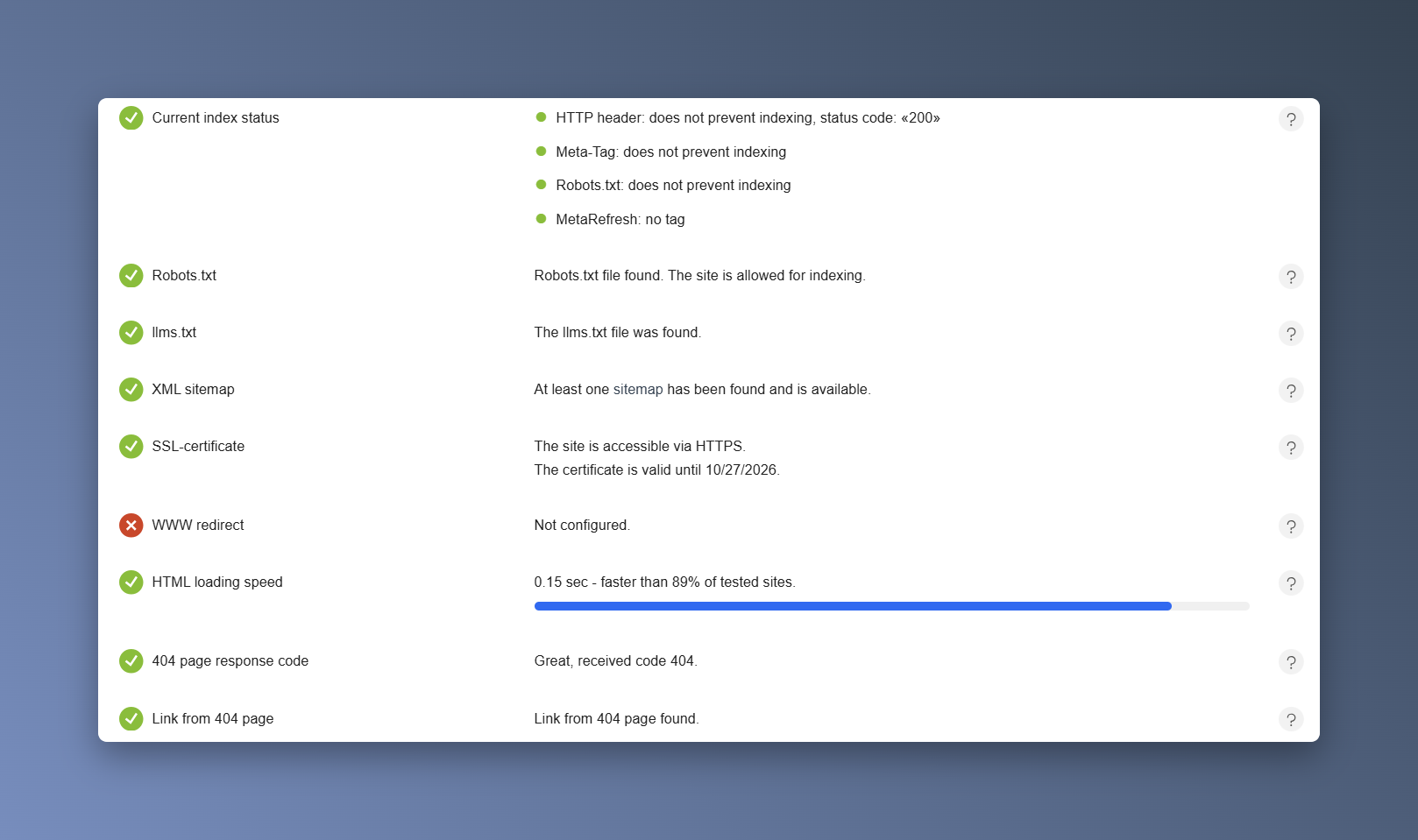
The main principle is simple: internal linking should be useful and manageable. In other words, you should understand which URLs you want to promote and which you want to keep out of the index, without creating chaos through your links.