
How to Increase Link Clickability in Search Results: Improving CTR for SEO
Brief Summary
CTR in search results directly affects the volume of organic traffic. If a page is already ranking in the top results, improving click-through rate often brings a fast increase in visits without expanding the semantic core.
We’ve gathered proven methods for Google and added a focus on tools and services that are accessible and convenient for users.
Who should read this article:
- SEO specialists who want to increase organic traffic without fully reworking the website;
- business owners and editors who optimize Titles, descriptions, and content structure;
- teams promoting sites in Google who want to see more clicks on priority pages.
What Organic CTR Affects
Organic CTR is the share of clicks on your snippet out of the total number of impressions in search. Formula: clicks / impressions * 100.
For SEO, three facts matter:
- A high CTR brings more visits even when the position remains stable.
- Clickability should be evaluated together with search intent and ranking position.
- Search results have become more crowded with special SERP features, quick answers, cards, and blocks with additional elements, so competition for the click has increased.
Behavioral signals and user satisfaction with the result are assessed by search engines in a complex way, and CTR is useful as a diagnostic metric for snippet quality and page relevance to the query.
If a query gets many impressions but few clicks, this is usually tied to one of four scenarios:
- a weak title,
- an irrelevant description,
- an uncompetitive snippet format,
- a mismatch with search intent.
CTR page evaluation checklist
- Compare a page’s CTR not with the whole site, but with queries ranking in the same position.
- Check the share of branded and non-branded queries separately.
- Evaluate seasonality and the news background so you don’t draw false conclusions.
FAQ on topic
Why can CTR drop while positions stay the same?
New SERP features, ads, marketplaces, or more noticeable competitor snippets may have appeared in the results.
What CTR is considered good?
There is no single universal number. Evaluate the metric within the context of ranking position, query type, and device.
Is it possible to grow traffic without improving rankings?
Yes, improving CTR on pages with a high number of impressions often gives a quick increase in organic traffic.
How to Write a Title That Improves CTR in Search
The Title remains the main element that affects click-through rate in search results. A good headline matches the user’s query, includes the key phrase, and clearly shows the page’s value.
What works in titles
- An exact keyword match closer to the beginning. For example, “how to improve CTR in search results” or “how to increase website CTR.”
- Specificity. Numbers, timeframes, format, and outcome make the snippet easier to understand.
- Relevance. For fast-changing topics, include the current year and update the content regularly.
- A clear format. Guide, checklist, case study, comparison.
Trying to boost CTR with loud promises is a weak approach. A title like that may bring clicks, but it worsens behavioral metrics if the content does not meet expectations.
For Google, it is also important that the Title is not over-optimized with keywords and is not duplicated across many pages. This is a common reason for low CTR.
Examples of titles for SEO and CTR
- How to Improve CTR in Google: 12 Proven Techniques for 2026.
- Low CTR in Search: 9 Reasons and a Step-by-Step Fix Plan.
- Clickable Page Snippet: How to Write Title and Description.
FAQ on topic
Should you always put the year in the Title?
No, use the year only for topics where information becomes outdated quickly.
How long should a Title be?
Focus on meaning and readability. Usually, the effective range is around 50–70 characters.
Can you use emojis in a title?
Yes, as long as the wording remains accurate and does not distort the meaning of the content.
What an SEO URL Should Be Like in Google
A URL is not the main click-through factor, but it does affect how a snippet is perceived. A short and clear address builds trust and helps users assess the page’s relevance more quickly.
URL rules for increasing CTR
- Use a human-readable address without unnecessary parameters.
- Include the page’s main topic in the slug, but avoid keyword stuffing.
- Keep a consistent folder and hierarchy structure across the entire site.
- Do not change URLs unless necessary, so you do not lose accumulated signals.
- Do not focus only on URL length. Readability, logical structure, and the absence of technical noise in the address matter more.
FAQ on topic
Does URL length directly affect rankings?
There is no direct dependency, but a clear and short address is perceived better by users.
How to Write a Clickable Description
A description is not always displayed exactly as written, but for most commercial and informational queries, it has a noticeable impact on a site’s CTR in search results.
How to write a description that gets clicks
- Start with the benefit. Explain what the user will get after clicking through.
- Add topic-relevant keywords. Search engines highlight matches, making the snippet more noticeable.
- Use specifics: a checklist, steps, timelines, numbers, or a list of tools.
- Write naturally: avoid keyword overload and empty promises.
The length of a description depends on the device and the query. Instead of following a strict limit, it is better to make the first part the strongest in meaning, so that even if the snippet is truncated, it still remains clear.
If the search engine regularly substitutes its own fragment instead of your description, check how well the page text matches the query intent and evaluate the quality of the above-the-fold content.
FAQ on topic
Should you duplicate the Title in the description?
No, it is better to complement the title with specifics and clear value for the user.
How many keywords should you add to the description?
Usually, 1–2 relevant keyword mentions in a natural phrasing are enough.
Why is the description not shown in search results?
The search engine may replace it with a page fragment if that provides a better answer to the user’s query.
How to Increase CTR in Search Results: Additional Methods
Expand snippet visibility with markup
Schema.org structured data helps search engines better understand the content type and can improve the visual appearance of the snippet. For articles, useful types include Article, FAQPage, BreadcrumbList, and Organization.
Strengthen the elements users see before clicking
- Add clear breadcrumbs and section headings.
- Make your favicon and site name recognizable.
- Align the H1, Title, and search intent so the snippet looks cohesive.
Work on branded demand
Growing brand awareness increases the likelihood of getting clicks even in competitive search results. To achieve this, it’s important to consistently publish useful content, maintain a unified style, and build your presence across relevant channels.
Check tools availability
For daily CTR work, it’s better to rely on services that are consistently available:
- Google Analytics for checking user engagement after the click;
- Google Search Console for data on impressions, clicks, and queries;
- Website analysis tool for technical and content diagnostics of pages.
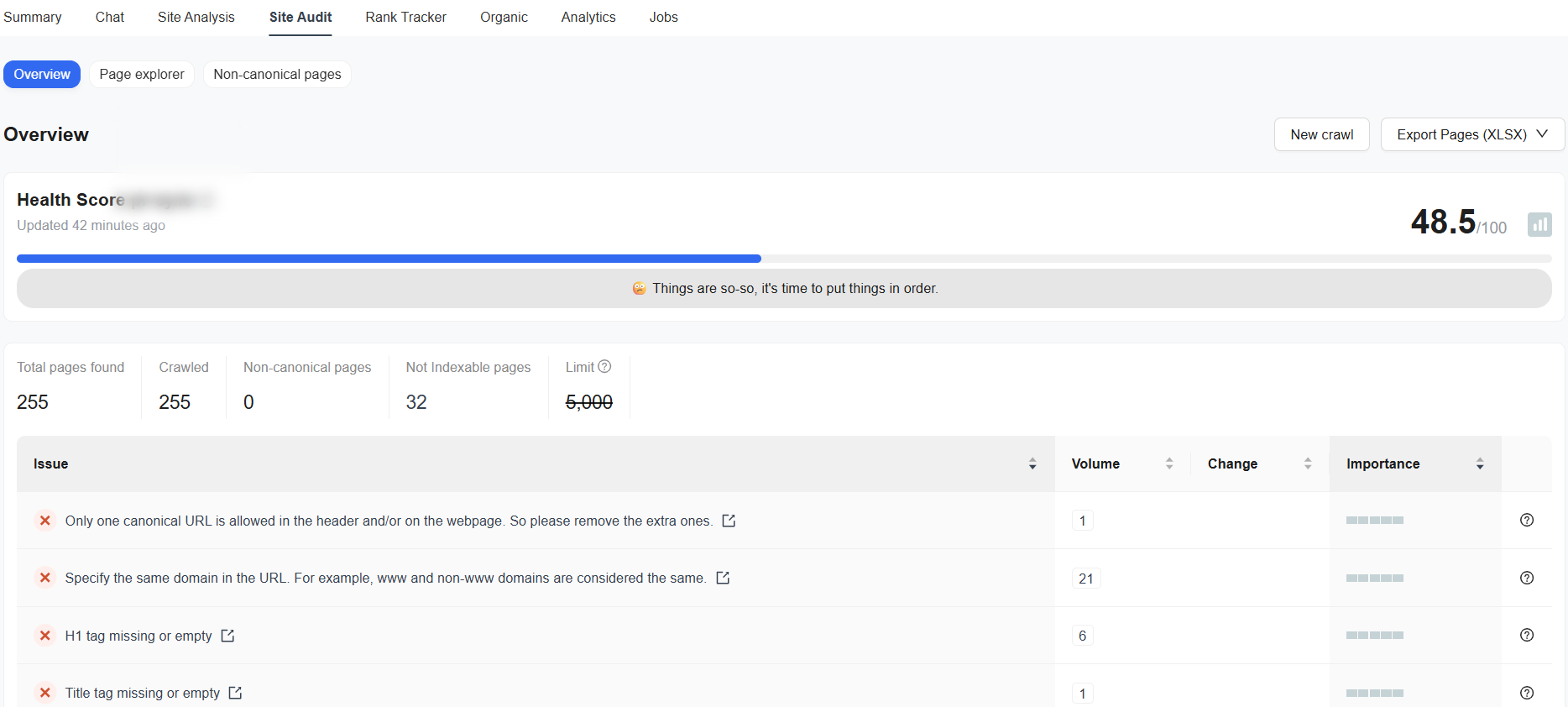
Website analysis tool interface
FAQ on topic
What delivers click growth the fastest?
Rewriting the Title and description of pages with a high number of impressions and a low CTR.
Do all pages need microdata markup?
No, but it’s necessary where it fits the content type and complies with search engine guidelines.
How to Analyze Page CTR and Find Growth Opportunities
Proper CTR analysis starts with segmentation. Review data separately by device, query type, and page group. This will help you identify the reasons for a drop faster and choose the right priority tasks.
Step-by-step CTR analysis plan
- Export queries and pages from Google Search Console.
- Filter pages with a high number of impressions and a CTR below the median for their position.
- Group queries by intent: informational, commercial, navigational.
- Update the Title, description, and above-the-fold content on priority URLs.
- Check the trend after 2–4 weeks and record the pages with positive results.
After CTR starts growing, monitor traffic quality in Google Analytics: page depth, bounce rate, time on page, and goal completions. This helps avoid situations where clicks increase, but the business result does not change.
For ongoing work, create a table with three statuses: testing, improved, and no effect. This simple process helps systematically increase CTR in search and scale successful solutions to other pages.
FAQ on topic
How often should snippets be updated?
For priority pages, check the data once every 2–4 weeks and update elements as needed.
Which group of pages should you start with?
Start with URLs that have a lot of impressions and noticeable click growth potential at their current positions.
When should you expect results after making changes?
Usually, the first changes become noticeable within a few weeks, but the timing depends on crawl frequency and niche competitiveness.
To increase your site’s CTR in search results, focus on a relevant Title, a strong description, a clear URL, and regular data analysis. The winning pages are the ones where the snippet accurately reflects user intent and quickly leads to useful content.