
What is GEO and How to Appear in AI Responses in 2025
Neural networks have altered the rules of website promotion. Nowadays, it is important not only to strive for the TOP-10 in search results but also to appear directly in AI-generated answers. We explain how to achieve this using the GEO strategy.
What is GEO
Traditional SEO aims at improving a website's position in search results. GEO, or Generative Search Engine Optimization, is a method to appear in the special results generated by AI-based platforms: Perplexity, ChatGPT and others.
 Search result in Perplexity
Generative search engines prefer content that is accurate, fact-checked, and rich in semantics. Such content can be confidently included in responses without distorting the context or adding outdated information.
AI is not limited to indexing; it analyzes meaning, assesses authority, and then merges multiple sources into a single response. If your content is not structured for easy information extraction, you remain invisible to the neural network, regardless of how refined your traditional SEO is.
The goal of GEO is simple — to train AI to perceive your site as a reliable source worthy of citation. Consequently, your content will be displayed in generative responses to questions within your niche.
What’s the Difference Between GEO and SEO
SEO and GEO are like close relatives with different personalities. SEO is a meticulous, introverted perfectionist who enjoys working with metadata and links. GEO, on the other hand, is a sociable extrovert who loves having its content cited.
Main Goal
Traditional SEO aims for visibility as a link in search results. The higher the position, the more clicks. GEO changes the tactic; its goal is visibility within the answer itself. AI systems don't care about keyword density; they prioritize information that is credible, well-structured, and easily retrievable.
Content Format
SEO teaches the creation and optimization of complete pages with meta tags, headings, and related materials. GEO, however, requires concise, modular content that is self-contained — a clear paragraph, a numbered list, or a comprehensive definition.
Tactics
SEO strategy is based on keywords and backlinks. GEO focuses on context, semantic richness, and direct citation. The more your content resembles a verified encyclopedic article — objective, accurate, and comprehensive — the higher the likelihood that AI will use it.
User Experience
In SEO, you "win" when a user clicks your link and visits your site. In GEO, the victory occurs even before the click — when your brand name and expert opinion appear in the AI's answer. This approach has one advantage: users who do click on a link from an AI response are usually more targeted and prepared. They already perceive your reputation, validated by the algorithm, and come to the site with conscious trust rather than mere curiosity.
Metrics
SEO operates with clear and familiar indicators: ranking positions, number of visits, conversions. GEO analytics metrics are still being developed. This is a "Roman Empire" for specialists who are asking new questions: How often are we cited? What proportion of AI responses mention our brand? Do these citations lead to an increase in direct brand queries?
Outcome
The ultimate goal of SEO is direct and measurable — to attract targeted traffic to the site. The impact of GEO is subtler and more strategic. When your content is consistently cited by AI, you strengthen the visibility and authority of the brand in an environment that users trust increasingly. GEO is not a replacement for SEO but its evolutionary continuation.
How to Implement GEO: A Step-by-Step Strategy
An effective GEO strategy is built on the solid foundation of classical SEO but requires a shift in focus.
Step 1: Master the Basics of SEO
SEO is inseparable from GEO. If your fundamental SEO foundations are weak, it will be exponentially more challenging to appear in AI responses.
Ensure the following points are addressed:
- Site Crawlability: Ensure that the website has a clean structure and no indexing issues.
- Page Load Speed: Ensure that the page load speed is sufficiently fast.
- Thoughtful Titles and Descriptions: Craft well-thought-out titles, descriptions, subheadings, and schema.org markup.
- Authoritative Backlinks: Secure authoritative backlinks.
- Content Updates: Regularly review and update materials to ensure content remains current and can be re-indexed.
Connect your website to our service to monitor rankings and identify errors with maximum convenience. You will receive notifications about all changes on your site within 24 hours — before the issue becomes critical.
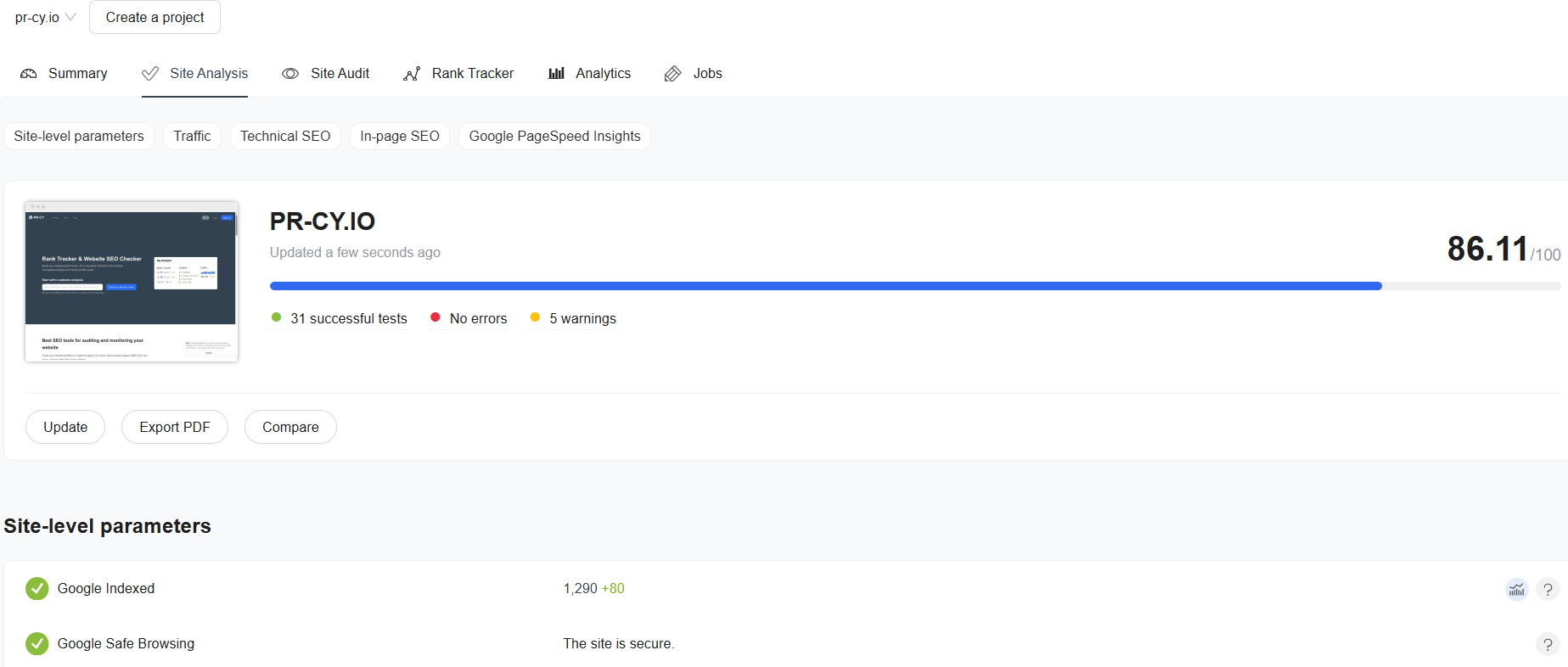 PR-CY Site Analysis interface
Additionally, platforms like ChatGPT and Perplexity may use sources far beyond the first page of search results if they provide good answers to user queries.
Step 2. Conduct Query Research
People interact with AI systems differently than they enter queries into Google. Instead of simple keywords like "best CRM software", queries look like dialogues: "What is the easiest and most effective CRM system for a small team?" If you want AI systems to promote your brand, you need to understand this difference.
- Study your data. Google Search Console can reveal long-tail search queries that are already leading to your site. A regex filter will help you find queries of 10 words or more. These are likely to be the same natural phrasing used in AI queries. You can find the list of regular expressions in the "Performance" section.
- Use keyword research tools. Modern services show which of your keywords are already triggering generative search results and whether your site is mentioned in them.
- Monitor thematic forums and blogs in your niche. There are many raw, unpolished questions. These are the communities where AI systems often dig when crafting responses.
Understanding how and what your audience is talking about will enable you to create content that perfectly fits AI-generated responses.
Step 3. Enhance Your Authority on the Topic
AI systems do not just search for a single article with an exact phrase match — they aim to identify which sources provide the most comprehensive and reliable coverage of the topic.
In other words, keywords are the building blocks, while topics are the blueprint. Without the blueprint, the building blocks are meaningless.
Instead of publishing individual articles with keywords, group related queries into clusters that together address a broader question.
This multi-level approach will enable AI systems to recognize your site as a primary resource on the topic:
- cover the key concepts,
- conduct comparisons and draw parallels,
- provide usage examples,
- address additional questions that naturally arise from the main query.
Step 4. Study User Intentions
In GEO, it is not enough to simply use keywords — you must align with their search intent.
Unlike traditional SEO, where ranking heavily depends on clicks and backlinks, generative search systems rely on contextual relevance. Your content should reflect the reason why the user is asking the question, not just the words they use.
Ensure that your content covers the four main types of intent:
- Informational. To answer queries like "What is...?" or "How does... work?", you can add guides, FAQ sections, and step-by-step instructions to your site.
- Commercial. Queries such as "Best tool for generating photos" or "Product A vs. Product B" drive decision-making. Target pages, comparisons, and reviews will help attract your audience.
- Navigational. Is the user asking about the prices or features of your product? You must have clear, indexable content on this topic. Otherwise, AI might fill your gaps with information from other sources.
- Transactional. Queries at the bottom of the funnel, such as "Buy ... online" or "Discount on...", should lead to pages with prices, promotions, and purchasing options.
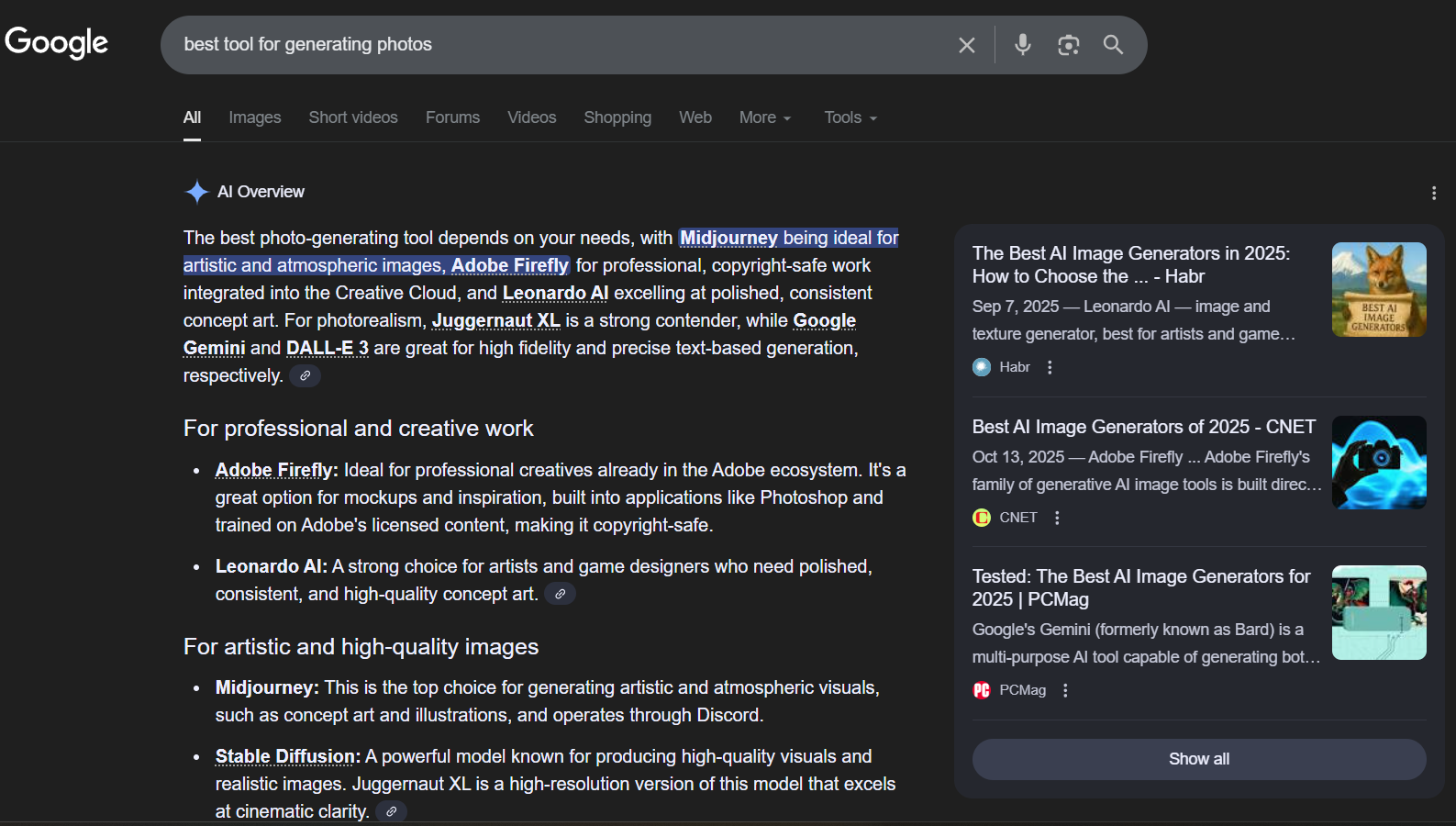 Search result in Google
Step 5. Use Formatting
Artificial intelligence systems prefer clear, structured, and easily digestible content. If your page resembles a wall of text, algorithms will find it harder to analyze.
Make your content easy to read by using:
- H2 headers for main sections.
- H3 headers for subtopics.
- Bullet points and numbered lists.
- Comparison tables.
- Bold text for key terms.
- FAQ sections.
Each section should be understandable on its own, as AI may extract just one paragraph for citation.
Use schema.org markup to provide search engines with additional information about your content. While this does not guarantee your site will be included in generative results, it will make the content easier to process.
Step 6. Work with Links and Mentions
- Add high-quality and authoritative backlinks.
- Monitor brand mentions. For example, if a post about "the best SEO tools for small agencies" becomes popular on a blog but does not mention your product, you need to address this.
- Use various sources simultaneously: blogs, media outlets, forums, and specialized websites.
- Choose the most current and relevant resources. Mentions and links to your brand in a niche-specific blog will be more effective than mentions in a general topic directory.
9 Main Mistakes in GEO
- Ignoring Intent — Optimizing solely for keywords without considering user intent.
- Unstructured Content — An abundance of text without headings, lists, and tables makes it difficult to analyze your content.
- Lack of Semantic Markup — Without structured data, AI has to guess what your content means.
- Focusing on Generic Keywords — Long conversational queries align with how users actually interact with AI.
- Neglecting Mobile Devices and Voice Input — If your site loads poorly on mobile devices or is not optimized for voice queries, you will miss out on a significant portion of AI search results.
- Crawling Issues — Heavy JavaScript, duplicate URLs, and broken links hinder bots from finding your content.
- Disconnection Between PR and SEO — If the PR department covers your brand in the media and SEO specialists do not account for this on the site, you miss the opportunity to enhance the resource's authority.
- Outdated Statistics, Non-Functional Links, and Irrelevant Data.
- Weak Authority — Superficial articles will not suffice; AI selects materials with in-depth and professional coverage of the topic.
Summary
GEO does not replace SEO but rather expands its capabilities. The fundamental principles remain important; however, the focus has shifted: from rankings to citation, from keywords to context, and from clicks to authority.
The primary principle of GEO is to create the most useful and reliable material that AI can find on the internet. Publish such content, and the neural network will make your brand a permanent part of its output.
🍪 By using this website, you agree to the processing of cookies and collection of technical data to improve website performance in accordance with our privacy policy.